
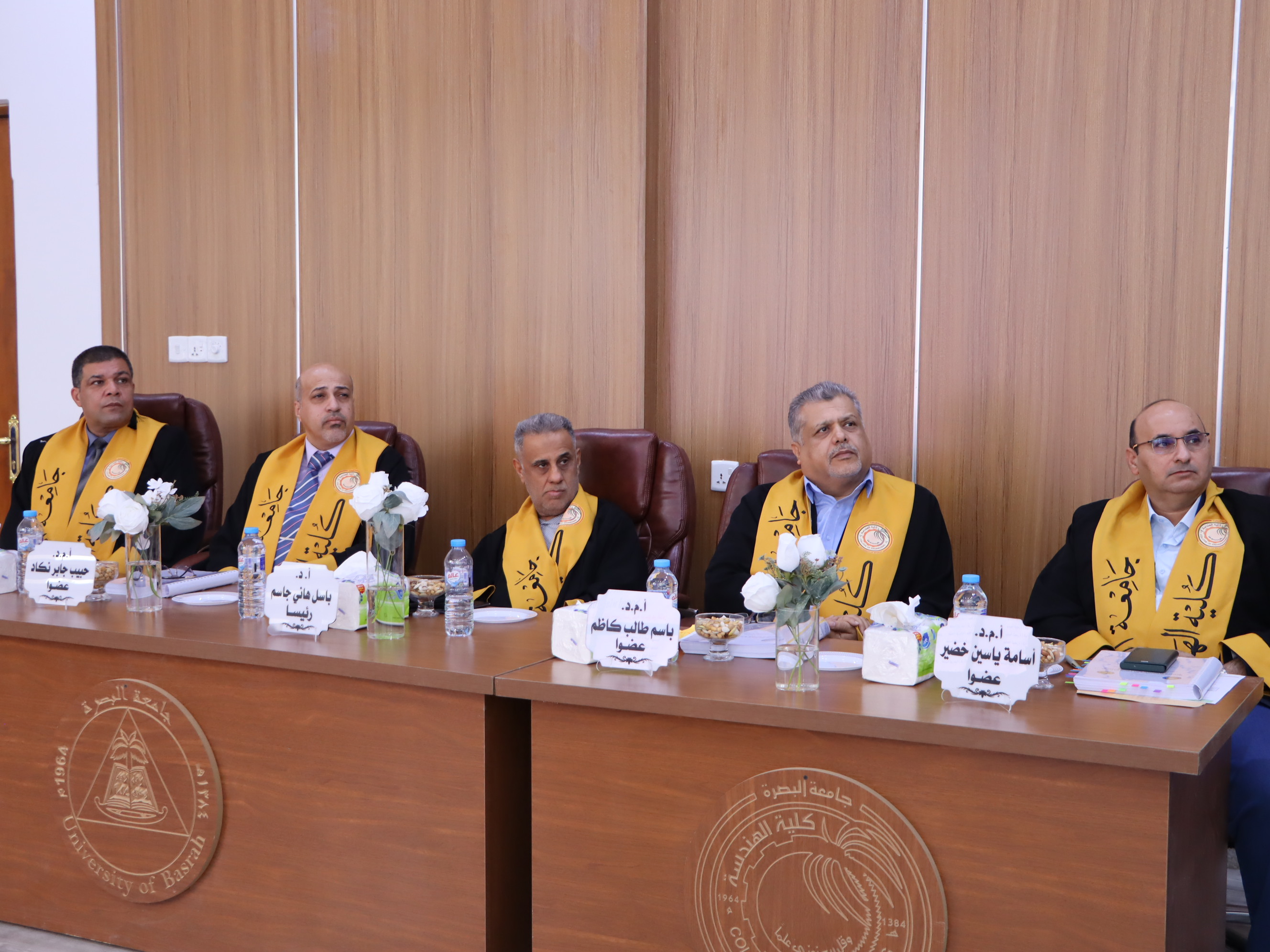
A Ph.D. dissertation was discussed at the College of Engineering, University of Basrah, entitled “Modeling, Control and the Effects on Power Systems of Variable Speed Wind Turbines.”
The dissertation, submitted by the student Ahmed Muthanna Nouri, addressed the modeling, control, and performance analysis of two variable-speed Wind Energy Conversion Systems (WECSs), namely the Doubly Fed Induction Generator (DFIG) system and the Permanent Magnet Synchronous Generator (PMSG) system, under wind-speed variations and voltage disturbances. The dissertation proposed a strategy to enhance the Fault Ride-Through (FRT) capability and improve Power Quality (PQ), using a Dynamic Voltage Restorer (DVR) fed by both a Supercapacitor Energy Storage System (SCES) through a Bidirectional Buck–Boost Converter (BBBC) and the DC-link of the Back-to-Back Converter (BTBC) of the studied Wind Turbine Generators (WTGs). The systems were modeled and simulated using MATLAB/Simulink and investigated under voltage sag, voltage swell, voltage flicker, and harmonic distortion.
The dissertation concluded that the PI–Deadbeat control strategy for the DVR achieved a faster response and higher accuracy than the PI–PI strategy under voltage disturbances. The improved control strategy of the BBBC enhanced the dynamic response, stabilized the DC-link voltage, and reduced voltage ripple, while the coordination strategy between the SCES and the Grid-Side Converter (GSC) helped prevent excessive charging and discharging of the supercapacitors, manage surplus energy, and maintain the DC-link voltage within its allowable limits.
Important News


viewed most