
Professor Dr. Ghaydaa Abdul-Razzaq Al-Suhail, a faculty member in the Computer Engineering Department at the College of Engineering, University of Basra, along with graduate student Hiba Ahmed Hussein, published a research paper titled:
"AlzONet: a deep learning optimized framework for multiclass Alzheimer’s disease diagnosis using MRI brain imaging" in the reputable international journal, The Journal of Supercomputing, published by Springer Nature Netherlands. The journal is indexed in the Scopus database with a Q1 Citscore of 6.9 in the field of computer science and mathematics, and a Q2 ranking in Web of Science (SCIE - Journal Citation Reports) (Clarivate), with a JIP impact factor of 3.5. Ranked Q2 Hindex 99 in Scimago SJR
Alzheimer’s disease (AD), characterized by progressive neurological degeneration and cognitive decline, necessitates early detection for effective intervention before symptom onset. Deep learning (DL) methodologies have emerged as promising tools for predicting and classifying AD. In this context, Convolutional Neural Networks (CNNs) exhibit proficiency in discerning specific AD features, enabling accurate diagnosis. To this end, this study proposes an effective deep learning optimized CNN model, namely, AlzONet, tailored to address the intricate challenges of Alzheimer’s patient brain classification. To explore the generalization of the AlzONet model through three gradient optimization algorithms: Adam, SGD, and RMSProp, this study focuses on how each algorithm impacts the model’s ability to minimize the loss function during training and how well it generalizes to new, unseen data. The Kaggle AD dataset, which includes normal, mild, very mild, and moderate stages, assesses the model’s performance. K fold cross-validation is applied to evaluate the model’s efficacy and generalization capability reliably. In contrast, a transfer learning-based comparison was conducted with five pre-trained models (VGG-16, DenseNet-121, ResNet-50, Inception-V3, and Xception). The results reveal that AlzONettrained with Adam achieves exceptional accuracy of 98.1% with a learning rate of 0.0001, while SGD and RMSProp yield 97.3% and 96.6% with a learning rate of 0.001 during training. In the testing phase, the optimized AlzONet model with Adam surpasses expectations with 96.5% accuracy, 96.7% F1-score, and 99.7% AUC.
https://link.springer.com/article/10.1007/s11227-025-06924-5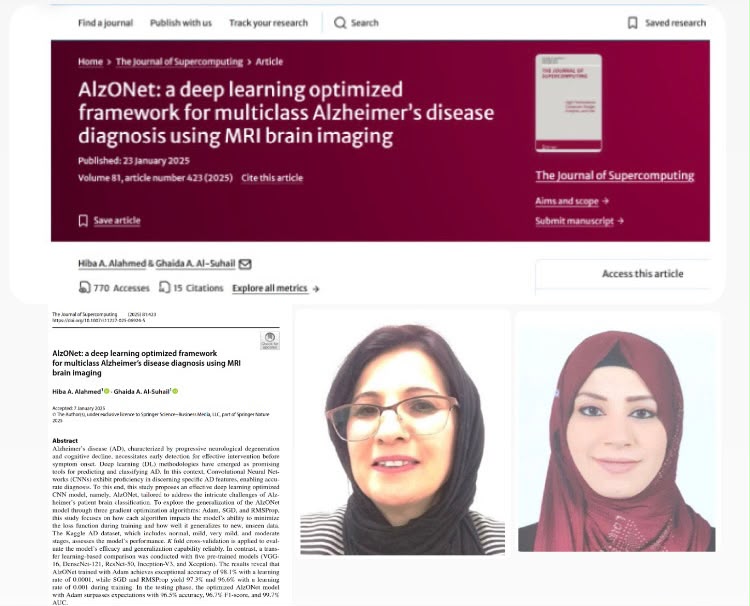
Important News



viewed most